Turnover Rate Calculator
Enter the leavers and the headcount to get the employee turnover rate for the period.
Recent
Your last 10 settings, saved only in this browser. Nothing is uploaded.
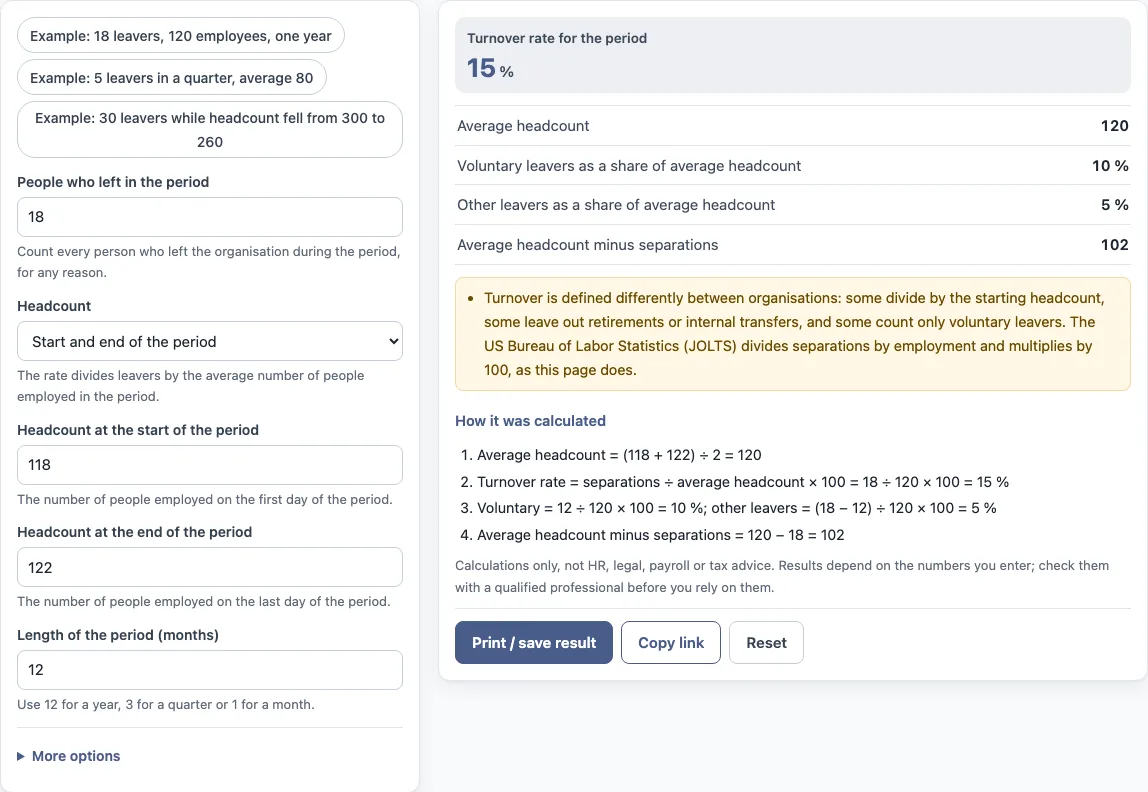
How to use the turnover rate calculator
- Enter the number of people who left in the period in “People who left in the period”. Count every person who left the organisation, for any reason.
- Under “Headcount”, choose “Start and end of the period”. Then fill in “Headcount at the start of the period” and “Headcount at the end of the period”. If you already have an average, choose “I know the average headcount” and type it into “Average headcount”.
- Enter the “Length of the period (months)”. Use 12 for a year, 3 for a quarter or 1 for a month.
- Optional: open “More options” and enter “How many of them left voluntarily (optional)” to split the rate into voluntary and other leavers. Leave it blank to skip the split.
- Read the results, starting with “Turnover rate for the period”. Open “How it was calculated” under the result to see each step with your numbers.
Three preset buttons fill the form with examples: “Example: 18 leavers, 120 employees, one year”, “Example: 5 leavers in a quarter, average 80”, and “Example: 30 leavers while headcount fell from 300 to 260”. “Reset” restores the example values.
“Copy link” copies a link that reopens the same inputs, and the page address keeps your inputs after each change. “Print / save result” prints a one-page sheet with the inputs, results, calculation steps and the date. To keep a PDF, choose save as PDF in the print dialog.
How do I calculate turnover rate? How do you calculate employee, staff or labour turnover rate, turnover percentage and turnover ratio?
Employee turnover rate is the number of separations in a period divided by the average headcount for that period, then multiplied by 100. A separation is one person leaving the organisation. Staff turnover and labour turnover are the same measure, so the formula for turnover rate is identical whichever name is used.
Average headcount is the mean of the headcount on the first and last day of the period: (headcount at the start + headcount at the end) ÷ 2. The tool’s worked example shows this with a start of 118 and an end of 122, giving an average of 120. With 18 separations, the turnover rate is 18 ÷ 120 × 100 = 15%. Of those 18, 12 were voluntary, so the voluntary share is 12 ÷ 120 × 100 = 10%, and the other leavers are (18 − 12) ÷ 120 × 100 = 5%.
For a period shorter than a year, the tool also shows an annualised rate: rate × 12 ÷ months in the period. This assumes the same pace continues for the full year, so it is an estimate, not a count of what happened.
How do you figure out, find, get, work out, determine, compute, estimate or measure turnover rate, employee turnover rate, staff turnover and turnover percentage?
Every one of these questions asks for the same calculation. Count the people who left in the period, work out the average headcount, divide the first by the second and multiply by 100. People also call this figuring turnover rate, the turn over rate formula or the formula for calculating turnover rate. To determine turnover rate for staff only, count only the staff who left and divide by the average staff headcount. To measure turnover for a different period, such as a month or a quarter, enter the number of months and read the annualised rate.
Which headcount do I divide by?
Divide by the average headcount for the period. The tool accepts either start and end headcounts, which it averages for you, or an average you already know. The US Bureau of Labor Statistics, in its Job Openings and Labor Turnover Survey (JOLTS), divides separations by employment and multiplies by 100, the same method this page uses.
Definitions vary between organisations. Some divide by the starting headcount instead. Some leave out retirements, internal transfers or the end of fixed-term contracts. Some count only voluntary leavers. If you compare figures from different sources, check which definition each one uses. The tool states the formula it uses under the result.
Turnover here means people leaving, not sales revenue.
Sources: US Bureau of Labor Statistics: Job Openings and Labor Turnover Survey, Wikipedia: Employee turnover.
Frequently asked questions
Is turnover the same as retention?
No. A turnover rate measures how many people left during a period. A retention rate is a separate measure, covered on the employee retention rate calculator page, and the two are not interchangeable.
What counts as a separation?
A separation is any person who left the organisation during the period. The tool asks you to count every leaver for any reason. Whether a particular group, such as retirements or transfers, should be included depends on how your organisation defines turnover.
What does the annualised rate show?
It shows the period’s rate scaled to a full year, using rate × 12 ÷ months. It assumes the same pace for all 12 months, so it can differ from what actually happens over a year.
Does the tool upload or store what I type?
Nothing you type is uploaded. The tool runs in your browser, and it requires no account or sign-up.
Can I use the results in a report?
Yes. Results may be used in commercial work, such as HR reports, policies, board packs and client documents, without attribution. Replace the example values with your own numbers first.
Does this tool give HR or legal advice?
No. The tool is arithmetic only. It gives no HR, legal, payroll or tax advice and does not say what a result means for any person.
Related tools
- Annual turnover rate calculator: use it when you want a rate for a full year.
- Employee retention rate calculator: use it when you want the share of staff who stayed.
- Attrition rate calculator: use it when you need an attrition figure instead of a turnover rate.
- Cost of turnover calculator: use it to estimate the cost of people leaving.
- Cost per hire calculator: use it to work out what recruiting a new person costs.
- Absence rate calculator: use it to measure time lost to absence rather than leaving.
- FTE calculator: use it to convert hours or headcount into full-time equivalents.