Full Time Equivalent Salary Calculator
Enter the part-time pay and the FTE to get the full time equivalent salary, or the reverse.
Recent
Your last 10 settings, saved only in this browser. Nothing is uploaded.
The full time equivalent salary calculator converts a part-time pay into the full-time salary it corresponds to. It can also work the other way, from a full-time salary to the part-time pay. You choose which figure you know, enter the FTE as a fraction or as weekly hours, and the results appear on the page. It runs in your browser, it is free, and no account or sign-up is needed.
The calculator shows the full-time equivalent salary per year, the actual pay per year, weekly figures, and an hourly rate. It uses pro-rata arithmetic only, so it is useful for checking the numbers behind a part-time post, a pay policy or an HR report. It does not replace the terms of an employment contract.
How to use the FTE salary calculator
- Under “What to work out”, choose “FTE salary from actual pay” if you know the part-time pay, or “Actual pay from an FTE salary” if you know the full-time equivalent.
- Enter the matching amount: “Actual annual pay ($)” for the part-time pay, or “FTE salary per year ($)” for the full-time figure.
- Under “Give the FTE as”, choose “A fraction (such as 0.6)” or “Hours per week”.
- If you chose a fraction, type it in the “FTE” box. If you chose hours, enter “Hours worked per week” and “Hours in a full-time week”.
- Read the results: “FTE salary per year”, “Actual pay per year”, “FTE used”, “FTE salary per week”, “Actual pay per week” and “Hourly rate on the FTE salary”.
- Open “How it was calculated” under the result to see each step with your numbers.
Three preset buttons fill the form with examples: “Example: $24,000 paid for half-time”, “Example: 18.75 of 37.5 hours a week” and “Example: 0.8 FTE of a $60,000 salary”. The values in the form at first are an example, not real company data, so replace every one with your own numbers. “Reset” restores the example values. “Copy link” copies a link that reopens the same inputs. “Print / save result” prints a one-page sheet with the inputs, results, calculation steps and date; choose save as PDF in the print dialog.
How to work out FTE salary
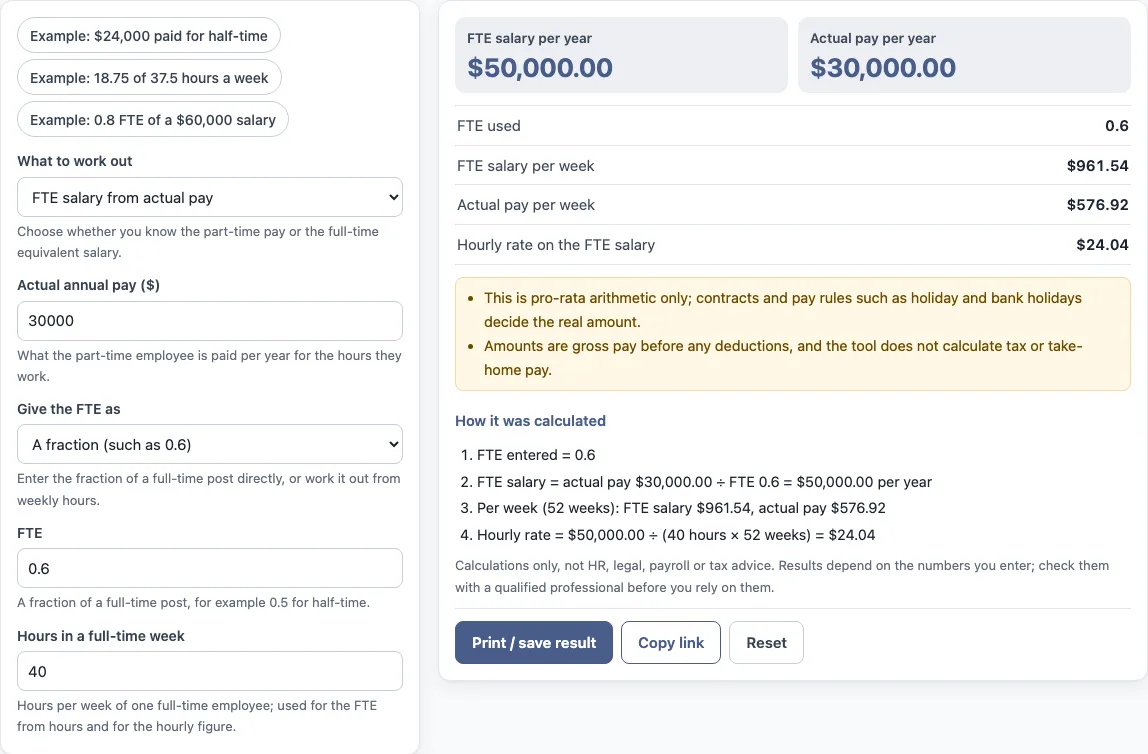
The FTE salary is the actual pay divided by the FTE. It is the full-time salary that a part-time pay corresponds to. In the tool’s worked example, $30,000 paid for a 0.6 FTE gives $30,000 ÷ 0.6 = $50,000 per year.
To go the other way, multiply the FTE salary by the FTE: actual pay = FTE salary × FTE. Using the same example, $50,000 × 0.6 = $30,000.
How to calculate FTE salary
FTE is a fraction of a full-time post, so 0.5 FTE means half-time. You can type the fraction directly, or work it out from hours: hours worked per week ÷ full-time hours per week. The tool uses the “Hours in a full-time week” value you enter for this step.
Organisations, contracts and countries can define full-time hours differently. Use the full-time hours stated in your own contract so the FTE matches the post.
How to calculate full time equivalent salary
Once the FTE salary per year is known, the tool divides it by 52 weeks to give the weekly figure. In the worked example, $50,000 gives $961.54 per week, and the actual pay of $30,000 gives $576.92 per week.
The hourly rate is the FTE salary divided by the full-time hours times 52 weeks. In the example, $50,000.00 ÷ (40 hours × 52 weeks) = $24.04.
These results are pro-rata arithmetic only. Contracts and pay rules, such as paid holidays and bank holidays, decide the real amount. The amounts are gross pay before any deductions, and the tool does not calculate tax or take-home pay.
What are the weekly and hourly figures for?
They put the same pay on other scales. The weekly figure is the annual figure divided by 52. The hourly rate is the FTE salary divided by the full-time hours per week times 52, so it describes the pay of a full-time post, not the part-time hours. In the worked example, $50,000 a year is $961.54 a week and $24.04 an hour for a 40-hour week, and the part-time pay of $30,000 is $576.92 a week. Both are gross amounts and use 52 weeks, so a contract that pays for fewer or more weeks will differ.
Frequently asked questions
How do I work out the full-time salary for a part-time job?
Divide the part-time annual pay by the FTE. In the worked example, $30,000 ÷ 0.6 = $50,000 per year. Enter the pay under “Actual annual pay ($)” and choose “FTE salary from actual pay”.
How do I work out part-time pay from an FTE salary?
Multiply the full-time equivalent salary by the FTE. In the worked example, $50,000 × 0.6 = $30,000 per year. Choose “Actual pay from an FTE salary” and enter the “FTE salary per year ($)”.
What if I only know the weekly hours?
Choose “Hours per week” under “Give the FTE as”, then enter “Hours worked per week” and “Hours in a full-time week”. The FTE is worked out from these two figures and shown as “FTE used”.
Are the results take-home pay?
No. The amounts are gross pay before any deductions. The tool does not calculate tax or take-home pay, and paid holidays and bank holidays can change the real amount.
Does the tool give advice on pay?
No. It is arithmetic only and gives no HR, legal, payroll or tax advice. It does not say what a result means for any person.
Why does the hourly rate use the full-time hours?
The hourly figure shown is for the full-time equivalent salary, so it divides by the hours of a full-time week times 52. Enter the full-time hours from the contract in “Hours in a full-time week”.
Related tools
- FTE calculator: use it when your main question is the FTE figure itself rather than a salary.
- FTE hours calculator: use it when you are working with hours rather than pay.
- Bradford factor calculator: use it when you want to score patterns of short-term absence.
- Absence rate calculator: use it when you want to measure absence as a rate.
- Span of control calculator: use it when you want to look at how many people a manager leads.
- Turnover rate calculator: use it when you want to measure how many people leave.
- Cost per hire calculator: use it when you want to measure what recruiting a new person costs.