Annual Turnover Rate Calculator
Enter a monthly rate, or leavers over some months, to get the annual turnover rate.
Recent
Your last 10 settings, saved only in this browser. Nothing is uploaded.
How to use the annual turnover rate calculator
- Under “Start from”, choose “A monthly turnover rate” if you already have a monthly rate, or “Leavers over some months” if you only have a count of leavers.
- If you chose a monthly rate, type your figure into “Monthly turnover rate (%)”. You can also select a preset such as “Example: 1.5 % a month” to see how the fields work.
- If you chose leavers, enter “People who left in the period” and “Average headcount”. Then set “Months covered (months)” to a number from 1 to 36.
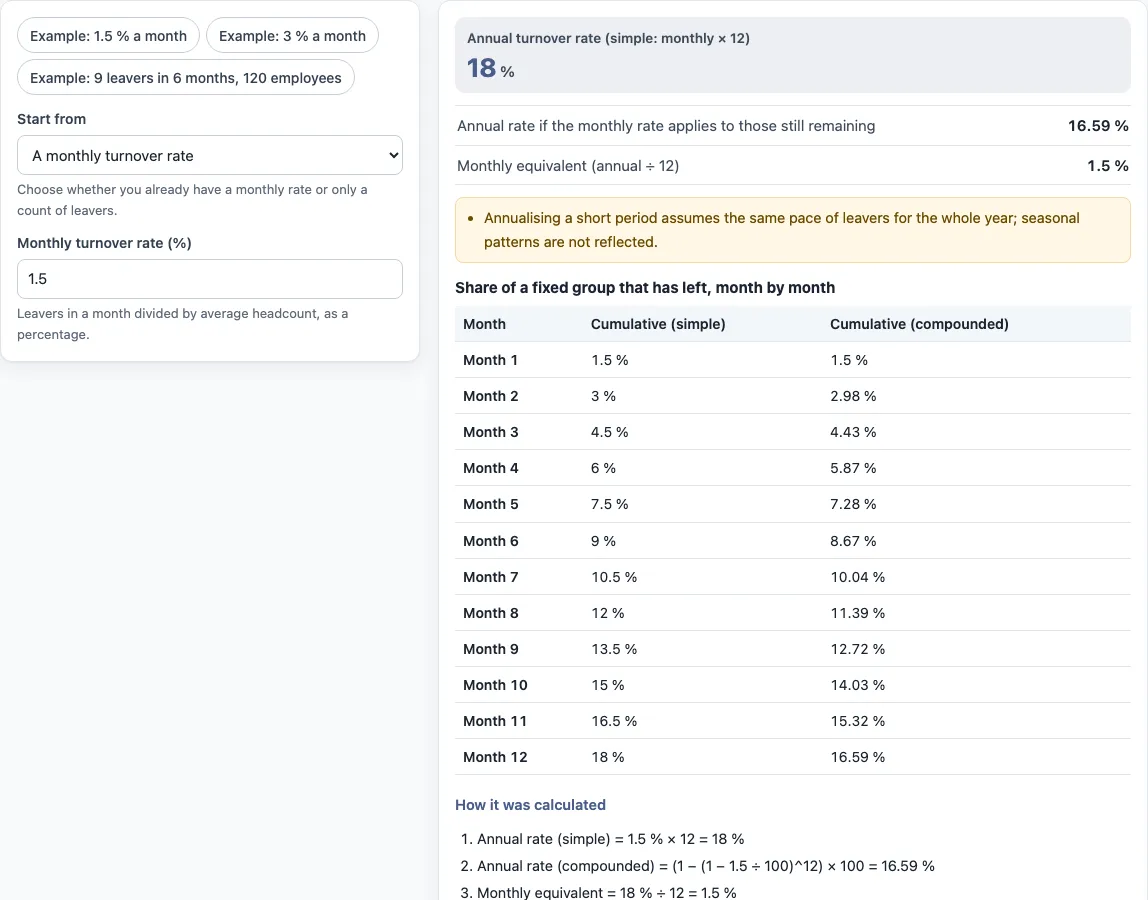
- Read the results: “Annual turnover rate (simple: monthly × 12)”, “Annual rate if the monthly rate applies to those still remaining”, and “Monthly equivalent (annual ÷ 12)”.
- Scroll to “How it was calculated” to see each step of the formula with your own numbers.
- Replace every example value with your own figures. The values already in the form are examples, not real company data.
“Print / save result” opens a one-page sheet with your inputs, results, calculation steps and the date. Choose “save as PDF” in the print dialog to keep a copy. “Copy link” copies a link that reopens the same inputs, and the page address keeps your inputs after any change. “Reset” restores the example values.
How to calculate annual or yearly turnover rate, annual staff turnover and how to work out annual turnover
An annual turnover rate turns a shorter-period figure into a yearly one. From a monthly rate, the simple method multiplies the monthly rate by 12, and the compounded method works out the share of a fixed group that would have left if the monthly rate applied to the people still remaining.
How to calculate annual employee turnover from leavers
The base formula is leavers ÷ average headcount × 100. When your leavers cover a period other than a year, annualise it with leavers ÷ average headcount × (12 ÷ months covered) × 100. The months covered can be any whole number from 1 to 36. For example, a count covering six months is scaled by 12 ÷ 6, which doubles it.
What is the difference between simple and compounded annual turnover?
Simple annual turnover is the monthly rate × 12, so it assumes every month’s rate applies to the same starting group. Compounded annual turnover assumes the monthly rate applies only to the people still employed each month, so each month’s leavers come from a smaller group. The tool’s compounded formula is (1 − (1 − monthly rate)^12) × 100.
With the default monthly rate of 1.5 %, the tool shows 18 % for “Annual turnover rate (simple: monthly × 12)” and 16.59 % for “Annual rate if the monthly rate applies to those still remaining”. The “Monthly equivalent (annual ÷ 12)” returns 1.5 %. The table of month-by-month results shows the cumulative simple and compounded rates over 12 months.
Can I annualise a short period?
Yes, the tool annualises any period from 1 to 36 months. The result assumes the same pace of leavers for the whole year. Seasonal hiring or one-off layoffs make an annualised figure unrepresentative, and the tool notes this under the result.
When is the compounded rate the better match?
Use the simple rate when the monthly rate is measured against a fixed starting group or you only need the monthly figure multiplied by 12. The compounded rate describes a different situation: each month’s leavers come from the people still employed, so the group shrinks. With a monthly rate of 1.5 % the two figures are 18 % and 16.59 %, and the gap widens as the monthly rate grows. The tool shows both so that you can match the definition your organisation uses.
Sources: Wikipedia: Employee turnover.
Frequently asked questions
How do you calculate annual turnover?
Divide the number of leavers by the average headcount, then multiply by 100 to get a percentage. If your figures cover a period other than a year, scale the result by 12 divided by the number of months covered. The “How it was calculated” section shows each step with your numbers.
Is annual turnover the same as the monthly rate multiplied by 12?
The simple annual turnover rate is the monthly rate multiplied by 12. The compounded version, shown as “Annual rate if the monthly rate applies to those still remaining”, is calculated differently and gives a lower figure. In the default example it shows 16.59 % against 18 % for the simple method.
Can I use these results in an HR report or board pack?
Results may be used in commercial work, such as HR reports, policies, board packs and client documents, without attribution. Use “Print / save result” to create a dated sheet with your inputs and steps.
Does the calculator tell me whether my turnover rate is acceptable?
No. The tool is arithmetic only. It gives no HR, legal, payroll or tax advice, and it does not say what a result means for any person or organisation.
Are the numbers I type uploaded anywhere?
The tool runs in your browser, and nothing you type is uploaded. It is free and requires no account or sign-up.
Related tools
- Turnover rate calculator: use it to work out a turnover rate for a single period rather than an annual figure.
- Employee retention rate calculator: use it when you want the share of staff who stayed over a period.
- Attrition rate calculator: use it to work out attrition for a group over a set time.
- Cost of turnover calculator: use it to estimate the cost side once you have a turnover figure.
- Cost per hire calculator: use it to work out what each new hire costs when replacing leavers.
- Absence rate calculator: use it to measure how much time staff are away from work.
- FTE calculator: use it to convert working hours into full-time equivalent figures for headcount.